


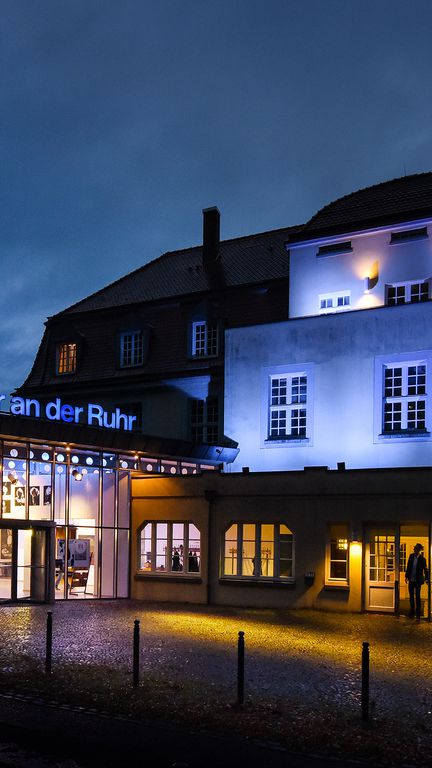
Quick Info
The more than thirty years which Roberto Ciulli spent here as artistic director, the unmistakable aesthetic which has been collaboratively developed over this time, and the collective structure which breaks away from that which is typically associated with a city theatre make the Theater an der Ruhr a spirited solitary figure in the German theatre scene.
A major life's work and a theatrical family
Born in 1934, Roberto Ciulli still gives introductions to performances which take place at the Theater an der Ruhr, shaking hands and having a chat here and there. Here, he probably feels surrounded by his life's work. Above all, he still acts as a director in this big theatrical project, which has achieved an unmistakable aesthetic due to his personal consistency over three decades. A measured pace, a certain element of darkness and forays into the absurd are characteristics which make many of his productions stand out.
Woody Allen's "God" and Peter Handke's "Kaspar", as well as Sophocles' "Antigone" and William Shakespeare's "King Lear", are all included within the repertoire of productions that he has directed during his time here. Over the past few years, he has developed a soft spot for classic buffoonery.
However, many individual players have contributed towards making the Theater an der Ruhr what it is today. Two such key players are dramaturge and co-founder Helmut Schäfer and stage designer Gralf-Edzard Habbenader. Habbenader, who died in 2018, always provided scenery which had a big impact yet was also suited for travel. This theatrical family also inspires loyalty among its acting members: Maria Neumann is currently the oldest serving actress at the Theater an der Ruhr, having first started working there in 1986.
Theatre which transcends borders
At the Theater an der Ruhr, theatre has always been active, multicultural and drenched in theory. For more than 30 years, international exchange which goes beyond the borders of the theatre's own cultural circle has been common practice: guest performance tours have seen the ensemble perform in countless German auditoriums – and have even taken them all the way to South America, Iran and Iraq. In turn, the Arabic-speaking artists' and theatre collective Ma'louba, which comes from Syria, is currently in residence at the Theater an der Ruhr. Over the past few years, the theatre has added more and more side projects to its programme, using the former Solbad Raffelberg spa in the Raffelbergpark on the city's border with Duisburg as a shared platform for doing so. As a citizens' theatre and inter-generational theatre, the VolXBühne addresses the questions surrounding an ageing Ruhr area, while the Junges Theater takes material which features on the reading lists of local students and puts it where dramas belong – on the stage.
A theatre in the service of art
We are opening a new chapter in the more than forty-year history of the Theater an der Ruhr – and continuing to write this history in the spirit of radical change. Since the beginning of the 23/24 season, the Theater an der Ruhr has been inviting audiences to three concentrated theater events that fall under the heading of a theme that will shape the entire season: In doing so, the theater is embarking on a completely new and radical path in Germany's theater landscape.
All new productions will be shown in these condensed “play islands.” Three times a year, over a period of four to six weeks, we invite you to these theater sessions, each of which comprises a unique program: In addition to the central theater productions, the audience can expect a theme-specific supporting program of workshops, concerts, art installations, readings, and lectures. Discussions and expert talks with specialists or further films and readings encourage us to think and participate.
These three theater islands are concentrated but playful structures of artistic work and social exchange. They are intended to bring us into contact with one another and reposition the theater in the social fabric as a collective space for thought and encounter. We would like to explore with you the deeper phenomena, formative forces, and longings that rise to the surface of our coexistence.


